 Quality Matrix
Over the past two years, AI capabilities have crossed several important thresholds. Large language models can now interpret requirement documents. AI systems can analyze codebases, identify testable scenarios, and generate executable test scripts with minimal human input. Autonomous agents can execute test suites, evaluate results, and flag anomalies with limited direct intervention.
For enterprises operating large, resource-intensive QA functions, the implication is significant. If AI can perform many testing activities faster, at greater scale, and at lower cost, a natural question arises: what is the future of the human role in software quality?
This is a question that requires a precise, evidence-based answer—not reassurance, and not alarm, but clarity.
What AI Can Genuinely Do in Software Testing Today
Before addressing the limitations of AI in quality engineering, it is important to be clear about its genuine capabilities—because they are significant, and underestimating them can lead to poor strategic decisions.
AI-Driven Test Generation
Modern AI-driven software testing services for enterprises can generate test scenarios at a scale and speed that no human team can match. By analyzing source code, functional requirements, and historical defect data, AI models can produce test cases that cover not only documented functionality but also edge cases, boundary conditions, and complex scenario combinations that human analysts often miss.
What previously required days of test design effort can now be produced in hours, with coverage that is broader, more systematic, and less dependent on individual experience or familiarity with the system.
Intelligent Test Prioritization
Not every test carries equal value in every release cycle. AI systems analyze the scope of code changes, historical failure rates, and risk profiles to determine which tests are most critical for a given build.
Instead of executing a full regression suite on every commit—a process that can significantly slow down pipelines—AI-powered quality engineering solutions prioritize test execution based on what is most likely to fail and what would be most costly if it does. The result is faster feedback cycles, more efficient use of infrastructure, and better allocation of human testing effort.
Self-Healing Test Automation
Test maintenance has historically been one of the most significant hidden costs in enterprise automation programs. When application interfaces change—and in modern development environments, they change frequently—automated test scripts break. Locators fail. Suites built over months require continuous effort just to remain functional.
Intelligent test automation and self-healing frameworks address this challenge directly. AI detects broken element locators, adapts to UI changes, and repairs automation scripts autonomously—eliminating a category of maintenance overhead that has traditionally eroded the return on automation investment.
This capability is central to Quality Matrix’s TGen AI platform, and it delivers a measurable and significant reduction in the total cost of ownership for enterprise automation programs.
Predictive Defect Analysis
By analyzing patterns across code commits, test execution history, and production incident data, AI systems can identify areas of an application that are statistically most likely to contain defects before testing begins.
This shifts quality engineering from reactive detection to true prediction. The objective of reducing software defects using AI-based testing is no longer a theoretical ambition—it is a capability that leading enterprises are operationalizing today.
What AI Cannot Do — And Why That Gap Matters
The capabilities described above are real. They are also incomplete.
AI in its current form operates within a fundamental constraint: it recognizes and optimizes based on patterns derived from existing data. Within the boundaries of known behavior, AI is extraordinarily powerful. However, when faced with genuinely novel conditions—the kind that define the highest-stakes quality scenarios in enterprise software—AI has significant limitations that cannot be overcome simply by deploying more sophisticated tools.
AI Cannot Exercise Business Judgment
When an experienced QA engineer reviews a requirement and recognizes that the described behavior—while technically correct—would create a poor user experience for a specific segment under real-world conditions, that is business judgment. It requires contextual understanding of customer behavior, organizational priorities, and usage patterns that exist beyond any training dataset.
AI does not possess this form of judgment. A skilled quality engineer does. In enterprise environments where software decisions carry significant business consequences, that distinction is not trivial.
AI Cannot Validate What Has Never Been Defined
AI-driven software testing services generate and execute scenarios based on available inputs: code, requirements, and historical data. However, some of the most critical failures in enterprise software occur in the gaps between requirements—in the assumptions that were never explicitly stated, the workflows that were not anticipated, and the failure modes that only emerge when real users interact with real systems under real-world conditions.
Exploratory testing—the discipline of investigating a system with informed curiosity rather than predefined scripts—remains one of the most powerful practices in quality engineering. It requires human intelligence, domain knowledge, and contextual awareness that AI cannot replicate. Exploratory coverage is not a supplementary activity. In complex enterprise systems, it is often where the most significant risks are uncovered.
AI Cannot Assess Strategic Release Risk
The decision to release software that contains known defects—balanced against delivery commitments, customer expectations, regulatory obligations, and business risk tolerance—is not a data problem. It is a judgment call that requires a deep understanding of organizational context.
No AI system makes that decision. A quality engineering leader with domain expertise and business acumen does.
AI Cannot Replace Domain Expertise in Regulated Industries
Quality assurance services for healthcare and fintech applications require deep, practical knowledge of regulatory frameworks such as HIPAA, FDA validation requirements for medical software, PCI-DSS controls, and SOX compliance obligations. In these environments, quality failures extend beyond technical defects—they carry legal liability, financial penalties, and, in healthcare, direct implications for patient safety.
Domain expertise in regulated industries is not a capability that can be automated. It is developed through years of experience, continuously refined against evolving regulatory standards, and remains one of the most critical assets a quality engineering partner brings to an enterprise engagement.

The Real Shift: From Test Execution to Quality Intelligence
The most useful reframing for enterprise technology leaders is not whether AI will replace software testing, but what AI makes economically viable—and how that shifts the strategic role of quality engineering within the organization.
For most of its history, QA has been defined by execution: writing test cases, running scripts, logging defects, and validating fixes. Value has traditionally been measured in coverage—how many scenarios were tested, how many defects were identified, and how thoroughly an application was validated before each release.
With AI-powered test automation services, where machine learning can generate, execute, maintain, and prioritize test scenarios at scale—with self-healing capabilities and intelligent risk analysis—the economics of execution fundamentally change. Human quality engineering capacity is no longer consumed by repetitive execution tasks. Instead, it is freed and redirected toward higher-value, strategic quality activities.
Those activities include:
Risk Architecture — Determining where quality investment delivers the greatest business protection, based on a clear understanding of the cost and impact of failure across workflows and user journeys.
Quality Strategy Design — Defining the testing frameworks, automation architecture, coverage governance, and delivery integration models that embed quality into the product rather than treating it as a post-development validation step.
Exploratory Investigation — Performing deep, context-driven quality analysis that uncovers failure scenarios AI is not designed to anticipate.
Continuous Improvement — Analyzing defect patterns, identifying systemic quality gaps upstream in the development lifecycle, and driving process changes that reduce defect injection rather than only improving defect detection.
This is what continuous testing in DevOps with AI tools looks like when applied with strategic intent—not simply faster automation, but a quality engineering function that operates as an intelligence layer embedded across the entire software delivery lifecycle.
How to Implement AI in Your Software Testing Strategy
For organizations actively evaluating how to implement AI in software testing strategy, the foundational insight is this:
AI amplifies the quality engineering capability an organization already has. It does not eliminate the need to establish that capability in the first place.
Organizations that deploy AI testing tools on top of an immature QA foundation—without clear risk frameworks, without robust automation architecture, and without quality engineering embedded into the development process—often find that AI amplifies existing problems as readily as it solves them. The principle of “garbage in, garbage out” applies to intelligent systems just as directly as it does to manual ones.
The path to genuine AI-driven quality maturity follows a deliberate sequence.
Step 1 — Establish a Strategic QA Foundation
Before AI can optimize a testing strategy, there must be a testing strategy worth optimizing. That means quality engineering is embedded throughout the development lifecycle—from requirements to release—supported by clear risk frameworks that define coverage priorities, and measurement models that track business outcomes rather than activity volume.
Step 2 — Build Automation With Intent
Automation suites should be designed around risk, not regression coverage for its own sake. Every automated scenario should exist because it addresses a specific failure mode with real business impact. This is the foundation on which self-healing frameworks and AI-driven optimization deliver meaningful value—not suites built to satisfy coverage metrics that are disconnected from what actually matters.
Step 3 — Introduce AI at the Right Capability Layer
AI delivers the most value where pattern recognition, scale, and speed are critical—such as test scenario generation, code change impact analysis, defect prediction, and test maintenance automation. AI capabilities should be introduced deliberately at these layers, while human quality engineers retain clear ownership of strategy, risk judgment, exploratory testing, and release decisions.
Step 4 — Measure Outcomes, Not Throughput
The success of an AI-driven quality engineering program is not measured by test execution volume or automation pass rates. It is reflected in production defect frequency, release confidence, customer experience stability, and the speed at which the organization can innovate without introducing quality risk into the systems its customers rely on.
Step 5 — Invest in Continuous Capability Development
AI models improve with data, while quality engineering capability improves through deliberate practice, domain expertise, and continuous learning. The organizations that will lead in AI-driven quality engineering over the next decade are those that treat both as ongoing strategic investments—not one-time technology implementations.
What This Means for Enterprise Technology Leaders
End-to-end quality engineering services for large enterprises are being reshaped by AI capabilities at an accelerating pace. The organizations navigating this transition most effectively are not asking whether AI will replace their QA teams. They are asking a more productive question:
How do we build a quality engineering function that applies AI where it excels—and human expertise where it is irreplaceable?
The answer varies by organization. It depends on the maturity of the existing QA function, the complexity of the technology landscape, the regulatory environment of the industry, and the pace and ambition of the ongoing digital transformation.
However, the strategic direction is consistent across enterprise contexts:
AI addresses scale, speed, and pattern-based analysis. Human expertise brings judgment, domain knowledge, strategic risk assessment, and exploratory intelligence. Together, they enable a quality engineering capability that neither can achieve independently.
For performance testing services for high-traffic applications in BFSI, healthcare, retail, and e-commerce—where performance failures under real-world load carry direct financial and reputational consequences—this is not an abstract strategic consideration. It is the difference between a quality program that genuinely protects the business and one that creates a false sense of security.
Conclusion: The Future Belongs to Both
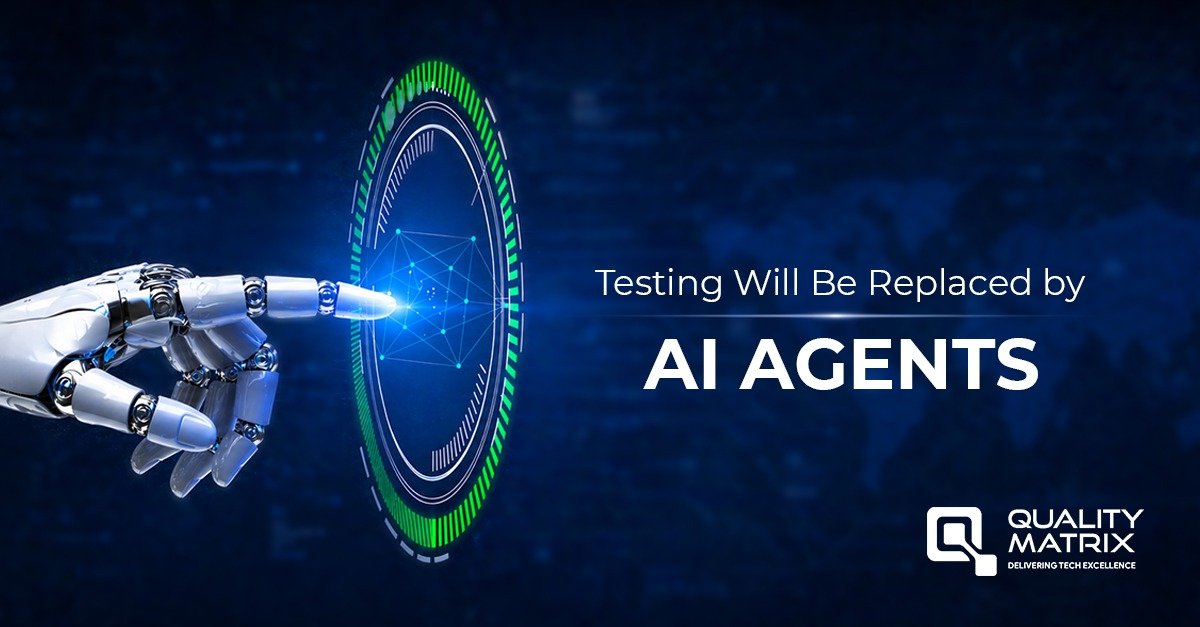
AI agents will not replace software testing.
They will replace the components of software testing that should have been automated long ago—the repetitive execution cycles, the maintenance overhead of fragile automation scripts, and the pattern-based test generation that consumes skilled capacity without delivering strategic value.
What remains—and becomes even more valuable as AI absorbs the execution layer—is human expertise: business judgment, domain knowledge, and quality intelligence that determines whether a software system is truly ready to serve the people and organizations that depend on it.
This is not a discipline in decline. It is a discipline in evolution.
The enterprises that recognize this distinction early, and invest in building quality engineering capability that combines AI’s scale with human expertise’s judgment, are the ones that will define what software quality looks like in the years ahead.
The question was never AI or human.
It has always been AI and human deployed intelligently, at the right layer, in service of the same goal that has defined quality engineering since its inception:
Software that works. Every time. For every user who depends on it.
FAQs
No. AI will actually enhance testing processes, but it cannot completely replace human expertise and strategic decision-making.
They are intelligent systems that automate and optimize testing tasks using machine learning and data analysis.
AI can analyze data, but cannot fully replicate human emotional understanding and usability judgment.