 Quality Matrix
Here is a number most enterprise QA teams never calculate.
On average, QA engineers spend 30–40% of their testing time investigating alerts that ultimately turn out to be false positives – inaccurate failure reports generated by automation systems that cannot distinguish between genuine defects and environmental anomalies.
This is far more than a minor inefficiency. At enterprise scale, it translates into hundreds of engineering hours each quarter spent chasing issues that do not exist, while real defects continue moving closer to production undetected.
False positives are not just a testing inconvenience. They represent a significant business cost that many organisations have long accepted as unavoidable.
AI is proving that assumption wrong.
Why Traditional Defect Detection Is No Longer Enough
Traditional testing systems were built for a simpler era — one defined by predefined scripts, static validations, and manual analysis of failure reports. When applications were smaller, release cycles were slower, and system complexity was manageable, this approach was sufficient.
Modern enterprise systems are none of those things.
Today’s applications operate across microservices, cloud-native infrastructure, third-party integrations, and real-time data pipelines. In this environment, traditional automation struggles in two critical and costly ways.
First, it generates growing volumes of false positives – inaccurate alerts that consume valuable engineering bandwidth without improving quality.
Second, it fails to detect the defects that matter most – the issues that emerge in the gaps between documented requirements and unpredictable real-world user behaviour.
The result is a QA function that is simultaneously noisy and incomplete.
Busy, but not effective.
How AI Changes Defect Detection Fundamentally
AI does not simply execute tests faster. It fundamentally changes how testing decisions are made – shifting QA from static, rule-based validation to intelligent, continuously learning quality analysis.
Predictive Defect Analysis
Traditional testing waits for failures to surface. AI changes that model by analysing historical test data, code change patterns, and defect trends to predict where failures are most likely to emerge before execution even begins.
High-risk modules receive deeper coverage. Critical workflows are prioritised earlier. QA effort is directed toward areas that deliver the greatest business protection.
This shift – from reactive detection to predictive prevention — is where AI creates its most significant enterprise value.
Intelligent Test Prioritisation
Not every test carries the same importance in every release cycle. AI identifies which components, workflows, and features are statistically most likely to fail based on code changes, release history, and real-world usage patterns — then prioritises execution accordingly.
The result is faster feedback, shorter pipeline cycles, and testing strategies aligned to business risk rather than historical habit.
Automated Root Cause Identification
When genuine failures occur, AI accelerates resolution by correlating logs, system behaviour, and failure patterns to identify probable root causes automatically.
Engineers spend less time debugging and more time resolving issues — significantly reducing the time between defect discovery and correction.

How AI Specifically Reduces False Positives
This is where AI delivers some of its most immediate and measurable enterprise value.
Intelligent Pattern Recognition
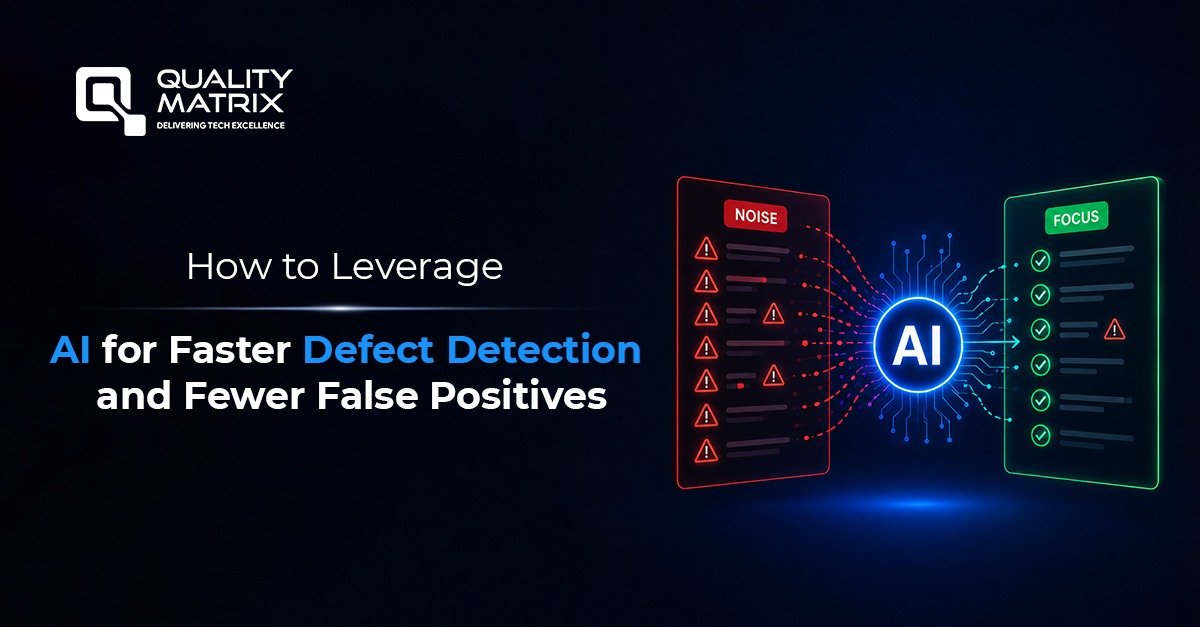
AI systems learn from historical execution behaviour to distinguish genuine failures from environmental anomalies such as network timeouts, unstable test environments, or timing inconsistencies that traditional automation often misclassifies as defects.
The result is simple but powerful: less noise, clearer signals, and faster identification of real issues.
Context-Aware Validation
Traditional automation evaluates outcomes in isolation. AI-driven systems assess multiple dimensions simultaneously — including environment conditions, workflow dependencies, user interaction patterns, and execution history — enabling far more accurate validation decisions with significantly fewer false alerts.
Testing becomes not just automated, but contextually intelligent.
Self-Healing Automation Frameworks
Minor UI updates, locator changes, and workflow modifications routinely break traditional test scripts, generating failure reports that require manual intervention to resolve.
Self-healing frameworks eliminate much of this overhead by automatically detecting changes and adapting test execution dynamically. The result is more resilient automation, greater suite stability, and the removal of an entire category of false-positive generation.
The Business Outcome That Matters
When false positives decrease and defect detection accuracy improves, the downstream business impact becomes immediate and measurable.
Engineering capacity once consumed by investigating inaccurate alerts is recovered and redirected toward higher-value quality initiatives. Release cycles accelerate because delivery pipelines are no longer slowed by unnecessary noise. Developer confidence in automation increases because testing outcomes become more reliable and trustworthy.
Most importantly, production defect rates decline because testing efforts are focused, intelligent, and predictive rather than reactive and repetitive.
Faster detection. Fewer false alarms. More reliable releases.
That is what AI-driven quality engineering delivers — and why leading enterprises are choosing to make the shift now rather than later.
How Quality Matrix Helps
At Quality Matrix, we help enterprises build AI-driven QA ecosystems designed for accuracy, scalability, and measurable business outcomes.
Through predictive defect analysis, intelligent test automation, self-healing frameworks, and AI-powered defect management, we help organisations move beyond the limitations and noise of traditional testing toward quality engineering that is smarter, faster, and aligned with real business priorities.
We do not just automate testing.
We build intelligent quality systems that continuously learn, adapt, and improve with every release cycle.
Ready to reduce false positives and accelerate defect detection across your enterprise?
 info@quality-matrix.com
  quality-matrix.com
FAQs
AI-driven defect detection combines machine learning, analytics, and intelligent automation to identify software defects faster, earlier, and with greater accuracy than traditional testing approaches.
AI reduces false positives in testing through intelligent pattern recognition, contextual analysis, and adaptive learning — enabling systems to distinguish genuine defects from non-critical anomalies with far greater accuracy.
Businesses can accelerate defect detection by adopting AI-driven QA systems, predictive defect analysis, and intelligent automation frameworks that identify high-risk issues earlier and improve testing accuracy across the release cycle.
Reducing false positives in software testing requires AI-powered validation, intelligent automation frameworks, and context-aware testing systems that can accurately distinguish real defects from environmental or execution-related anomalies.
AI-driven QA enhances scalability, testing efficiency, release speed, and software reliability while significantly reducing operational overhead and quality assurance costs.