 Quality Matrix
In Banking, a Bug Is Never Just a Bug
A minor software issue in banking is never just a bug.
It becomes a compliance violation. A financial risk. A security vulnerability. A direct loss of customer trust within seconds.
That’s not a metaphor. That’s the operational reality of every financial institution shipping software today.
The Pressure Is Real. And It’s Only Growing.
Banks are under constant pressure to deliver secure, compliant, high-performing applications while managing growing customer expectations and increasingly strict regulatory standards.
Today’s banking systems process millions of real-time transactions, sensitive customer data, payment workflows, and critical financial operations every single day across:
- Mobile banking platforms
- Payment gateways
- Digital wallets
- Core banking systems
- API integrations
- Cloud-native banking services
Every layer adds complexity. Every integration adds risk. And in this environment, software quality assurance is no longer optional. It has become a critical business requirement.
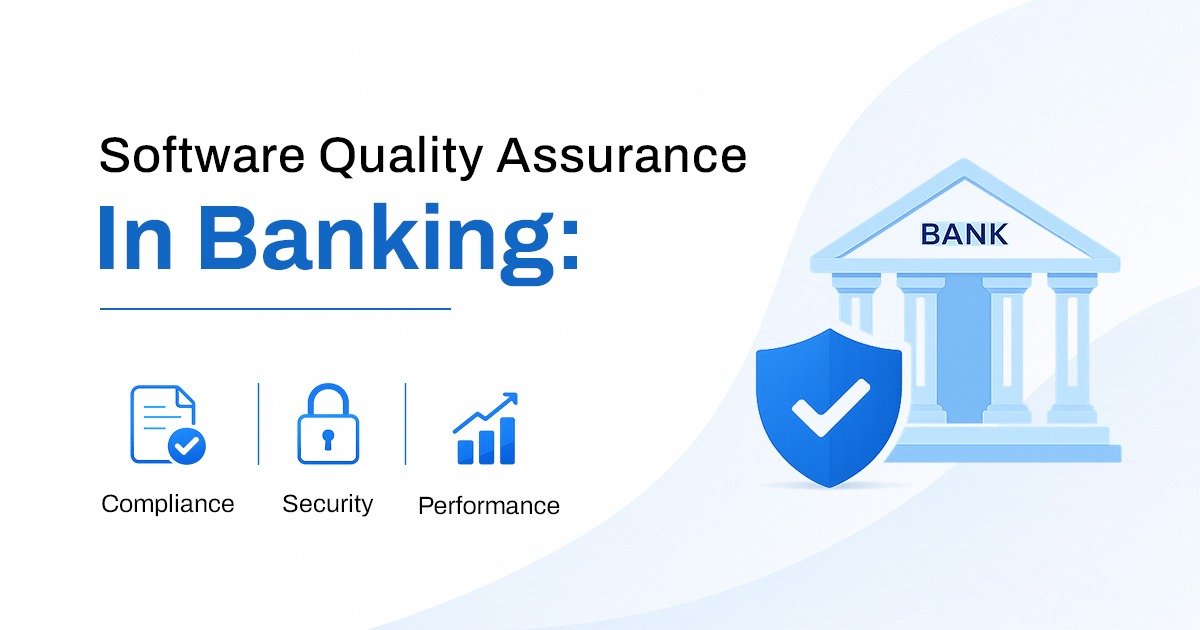
Three Pillars That Cannot Be Compromised
1. Compliance Testing — Because Regulations Don’t Wait for Your Release Cycle
Banking applications must comply with:
- PCI DSS
- GDPR
- ISO standards
- RBI guidelines
- AML and KYC regulations
Compliance must be continuously validated throughout the software lifecycle — not just before deployment.
Effective banking compliance testing reduces:
- Regulatory risks
- Audit failures
- Data governance issues
- Operational vulnerabilities
Organizations that treat compliance as a final checkpoint are one regulatory shift away from serious consequences.
2. Security Testing — Because Banking Data Is Always a Target
Banking applications are prime targets for cyberattacks due to the highly sensitive nature of financial data. Modern banking software security testing includes:
- Penetration testing
- Vulnerability assessments
- API security validation
- Identity and access testing
- Encryption verification
- Secure transaction testing
These aren’t enterprise luxuries. They’re baseline requirements for any organization handling financial data at scale. As digital banking adoption grows, secure applications have become essential for maintaining customer confidence and protecting financial ecosystems.
3. Performance Testing — Because Failures Always Choose the Worst Moment
Banking platforms must perform reliably under heavy transaction loads, peak user activity, and real-time financial operations. Banking performance testing helps organizations evaluate:
- System scalability
- Transaction processing speed
- Platform stability
- Application responsiveness
- Infrastructure resilience
Even a small performance issue during high-volume periods directly impacts customer experience, transaction reliability, operational continuity, and business revenue.
The Challenges Are Real. Traditional Testing Isn’t Enough.
Modern banking software ecosystems introduce several testing challenges, including:
- Legacy system integration
- Complex transaction workflows
- High regulatory requirements
- Real-time data processing
- Cybersecurity threats
- Multi-platform user experiences
- Cloud migration complexities
Traditional testing approaches struggle to address these rapidly evolving demands. This is why many organizations are shifting towards:
- Intelligent automation
- AI-driven QA
- Continuous testing
- Shift-left quality engineering
- Risk-based testing strategies
Modern enterprise banking requires smarter, scalable, and security-focused quality engineering practices.
The Role of AI and Automation in Banking QA
AI-powered testing and intelligent automation are transforming banking software quality assurance. Modern AI-driven QA systems help organizations:
- Accelerate defect detection
- Improve test coverage
- Reduce false positives
- Identify security risks faster
- Optimize regression testing
- Improve release confidence
Automation also enables continuous validation across CI/CD pipelines, helping banking organizations deliver faster while maintaining compliance and reliability. As banking systems become more digital and interconnected, intelligent QA ecosystems are becoming essential for long-term operational resilience.

How Quality Matrix Ensures Software Quality Assurance in Banking
At Quality Matrix, we help banking and financial organizations build secure, compliant, and scalable quality engineering ecosystems designed for modern digital banking environments.
Our expertise includes:
- Banking application testing
- Compliance testing
- Security testing for banking platforms
- Performance engineering
- API testing
- AI-driven QA
- Intelligent automation frameworks
- Continuous testing strategies
- Enterprise quality engineering
We focus on helping financial institutions improve:
- Release confidence
- Platform stability
- Regulatory compliance
- Operational efficiency
- Customer trust
At Quality Matrix, we don’t just test banking applications. We engineer quality systems built for secure and scalable digital banking transformation.
This Is Not Just a Technical Requirement Anymore
Software quality assurance in banking is no longer just a technical requirement.
It is a strategic business necessity.
Organizations that prioritize compliance, security, and performance-driven quality assurance are better positioned to deliver resilient banking experiences, strengthen customer trust, and achieve sustainable growth in an increasingly digital financial landscape.
What’s the biggest quality challenge your banking platform is facing right now?
FAQs
Software quality assurance in banking helps ensure application security, regulatory compliance, transaction reliability, operational stability, and seamless customer experiences in highly sensitive financial environments.
Compliance testing validates whether banking applications meet regulatory standards such as PCI DSS, GDPR, AML, KYC, and RBI guidelines, helping organizations reduce legal and operational risks.
Banking systems manage sensitive financial and customer data, making them prime targets for cyber threats. Security testing helps identify vulnerabilities, prevent breaches, and ensure secure financial transactions.
Performance testing evaluates how banking systems perform under heavy transaction loads, peak traffic, and real-time operations to ensure scalability, speed, and platform stability.
Quality Matrix helps banking organizations build secure, scalable, and compliance-focused QA ecosystems through intelligent automation, AI-driven testing, performance engineering, and enterprise