 Quality Matrix
Most enterprises make the same mistake when the conversation about a Testing Center of Excellence begins.
They frame it as a testing decision.
It is not.
A TCoE is an organizational design decision one that sits at the same level of strategic consequence as how an enterprise structures its engineering leadership, governs its technology investments, or organizes its delivery capability. The organizations that treat it as a testing initiative get a testing initiative. The organizations that treat it as an organizational design investment get something considerably more valuable: a quality engineering capability that is structurally embedded into how the enterprise operates rather than bolted onto the outside of it.
This distinction matters because the problems a Testing Center of Excellence solves are not testing problems. They are organizational problems that manifest as testing failures and treating the symptom without addressing the structural cause is precisely why so many quality improvement initiatives produce activity without transformation.
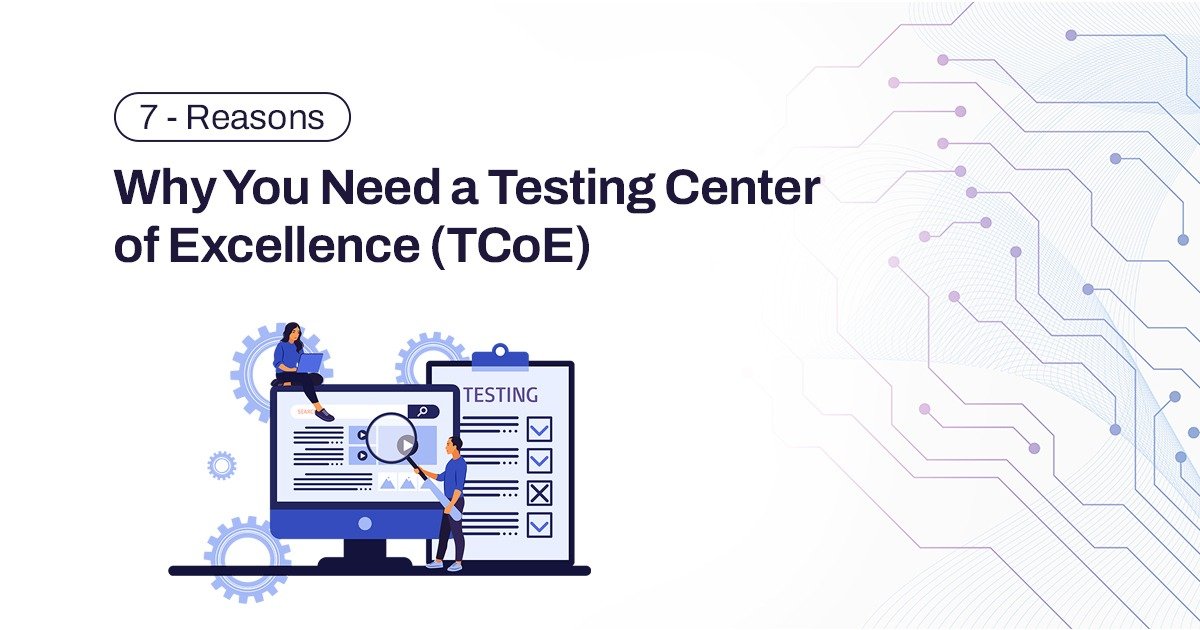
These are the seven organizational reasons why your enterprise needs a TCoE written not for QA leaders managing test suites, but for enterprise leaders designing the organizations that ship software.
What a Testing Center of Excellence Actually Is — From an Organizational Perspective
Before addressing why enterprises need one, it is worth reframing what a Testing Center of Excellence in software testing actually represents at the organizational level.
A TCoE is a center of gravity for quality engineering capability within the enterprise. It is the organizational structure that determines where quality expertise lives, how quality standards are set and enforced, how quality investment is governed and allocated, and how quality outcomes are measured and reported to leadership.
In its absence, all of those things still happen but they happen differently everywhere, governed by nobody centrally, measured inconsistently, and aligned with team-level priorities rather than enterprise-wide outcomes.
The TCoE framework does not add a new function to the organization. It gives an existing function quality engineering the organizational structure it needs to perform at the level the enterprise requires.
Reason 1: Accountability Without Structure Produces Activity Without Outcomes
Nobody in an enterprise without a Testing Center of Excellence is unaccountable for quality.
Every delivery team lead is accountable for quality within their team. Every QA engineer is accountable for the test cases they execute. Every product manager is accountable for the features they ship. Everyone is accountable. And yet production failures happen consistently, quality outcomes vary significantly across teams, and when leadership asks who is responsible for the enterprise-wide quality posture, the honest answer is that nobody specifically is.
This is the organizational paradox that distributed accountability creates. When everyone owns quality, nobody owns it at the level where strategic decisions about quality are made where standards are set, where investment is allocated, where the trade-offs between delivery velocity and quality risk are resolved with genuine authority and enterprise-wide perspective.
A TCoE resolves this paradox not by removing team-level accountability but by adding the organizational layer above it that was missing a centralized function with genuine authority over quality standards, genuine visibility into enterprise-wide quality outcomes, and genuine accountability for the quality engineering capability the organization deploys.
The organizational chart change is simple. The consequence of making it is significant. And the consequence of not making it is the accountability gap that most enterprise quality failures trace back to when their root causes are examined honestly.
Reason 2: Every Delivery Team Is Solving the Same Problems Independently and Nobody Is Noticing
Walk through the delivery teams of most large enterprises and you will find the same conversations happening in parallel independently, without awareness of each other, and without the organizational mechanism to turn individual solutions into shared assets.
Team A spent four months evaluating automation tooling and settled on an approach that works well for their context. Team B is six weeks into the same evaluation, arriving at different conclusions for reasons that have more to do with individual preference than organizational strategy. Team C solved an integration testing challenge eighteen months ago that Team D is currently struggling with but there is no organizational structure through which Team C’s solution becomes Team D’s starting point.
This is not a communication failure. It is a structural failure.
Without a centralized testing strategy governed through a TCoE, the organizational knowledge generated by every quality engineering decision made across the enterprise remains local. It does not transfer. It does not compound. It does not become the institutional capability that makes the next team faster, the next project better covered, or the next technology adoption less costly to validate.
A Testing Center of Excellence is the organizational structure that converts individual solutions into shared assets creating the knowledge transfer mechanisms, the shared framework libraries, the documented decision rationale, and the community of practice infrastructure that makes quality engineering knowledge an organizational resource rather than a team-level one.
The financial argument for this is straightforward. The organizational argument is more important: enterprises that cannot transfer knowledge structurally are paying the full cost of every solution every time it needs to be found across every team, every project, and every technology generation. That is not a quality cost. It is an organizational design cost.
Reason 3: The Reporting That Reaches Leadership Is Not Telling the Truth
This is the organizational challenge that enterprise leaders are least likely to recognize from within, because the very reporting mechanisms that obscure the true state of quality are often the same ones they rely upon to assess it.
In organizations without a centralized QA governance framework, quality metrics are often aggregated from teams that define quality differently, measure test coverage differently, classify defects differently, and apply different criteria for release readiness. While each team’s reporting may be internally consistent, the lack of standardization creates significant challenges when metrics are consolidated at the enterprise level.
By the time this information reaches executive leadership, disparate measures have been combined into a single dashboard that appears coherent and actionable. In reality, it often represents a synthesis of inconsistent definitions, methodologies, and assumptions—creating the illusion of a unified view of quality while masking the underlying variability across the organization.
The dashboard looks healthy. Coverage levels appear strong. Defect trends are moving in the right direction.
Then a critical production failure occurs—one that the reported quality metrics never signaled.
The reason is often not a lack of data, but a lack of consistency. The metrics reflected what individual teams chose to measure, how they chose to measure it, and how results were reported within their own contexts. Without a centralized governance framework to standardize definitions, measurement methods, and reporting practices, there is no objective baseline against which the accuracy or meaning of those metrics can be validated.
As a result, organizations can become highly effective at reporting quality performance while remaining surprisingly ineffective at understanding actual quality risk.
A TCoE solves this as an organizational design problem rather than a reporting problem. It establishes the measurement standards, metric definitions, and reporting frameworks that make quality data comparable, aggregable, and genuinely informative at the leadership level not because teams are asked to report differently but because the organizational structure that governs how quality is measured has been established centrally.
The Testing Center of Excellence benefits that enterprise leadership most frequently describe after implementation are not primarily operational. For the first time, leadership has a quality view they can trust, make decisions on, and use to hold the organization accountable.
That value is not primarily a quality outcome—it is a governance outcome. It provides the trusted visibility, consistency, and accountability that effective quality management depends upon. More importantly, it establishes the foundation on which every subsequent organizational improvement can be built.
Reason 4: Your Quality Investment Is Allocated by Accident, Not by Strategy
In enterprises without centralized quality engineering governance, investments in quality—whether in headcount, tooling, automation, or external partnerships—are often allocated through processes that few organizations would consider truly strategic upon honest examination.
Budget is distributed to delivery teams based on project scope and historical precedent. Each team allocates its quality budget based on its own priorities, its own tool preferences, and its own assessment of where coverage is most needed. Tooling decisions are made locally, producing a vendor landscape across the enterprise that nobody centrally manages, negotiates, or optimizes.
The cumulative result is a quality investment portfolio assembled by organizational accident rather than strategic intent one where the total expenditure significantly exceeds what centralized procurement and governance would require, where the collective output delivers less than a coordinated investment strategy would produce, and where the allocation has no visible connection to the enterprise-wide quality risks that leadership is actually trying to manage.
A TCoE implementation changes this as an investment governance decision. It centralizes the authority to make quality investment decisions at the organizational level evaluating tooling against enterprise requirements rather than team preferences, allocating automation investment where it produces the highest enterprise-wide return, negotiating vendor relationships with the leverage of consolidated demand, and ensuring that the quality investment portfolio is connected to the quality outcomes the enterprise is accountable for.
This is not QA budget management. It is enterprise investment governance applied to a domain that most organizations have never governed at that level.
The software testing strategy that emerges from centralized investment governance is categorically different from the one that emerges from distributed, locally optimized allocation and the financial difference between them is consistently larger than enterprises anticipate before they measure it.

Reason 5: The Organizational Distance Between Quality and Leadership Is Costing You Strategic Decisions
In most enterprise org charts, quality engineering sits several layers below the leadership conversations where technology strategy, delivery investment, and risk management decisions are made.
This organizational distance has consequences that extend well beyond reporting latency.
When quality engineering is not represented at the level where strategic technology decisions are made, those decisions are made without the quality perspective that would change them. A platform migration scoped without quality engineering input underestimates validation complexity. A delivery acceleration initiative approved without quality engineering involvement sets velocity targets that the quality infrastructure cannot support. An AI adoption programme approved without quality engineering governance creates compliance and reliability risks that surface in production rather than in the decision that introduced them.
These are not testing failures. They are organizational design failures consequences of a structure that positions quality engineering as an execution function rather than a strategic one.
A Testing Center of Excellence elevates quality engineering to the organizational position it needs to occupy to influence the decisions that determine quality outcomes before those decisions are made, not after their consequences have surfaced.
The QA center of excellence is the organizational structure that gives quality engineering a seat at the strategic table not as a representative of testing operations but as a steward of the enterprise’s quality risk posture, with the authority and visibility to shape the technology and delivery decisions that quality risk depends on.
Reason 6: Your Enterprise Is Scaling Its Delivery Ambition Without Scaling Its Quality Governance
Growth creates a quality governance challenge that most enterprises fail to anticipate until they are already experiencing its consequences.
Quality engineering at scale the capability that allows an enterprise’s quality function to govern effectively across a growing, diversifying, and accelerating delivery organization is not an outcome of hiring more QA engineers. It is an outcome of building the organizational structure that multiplies the effectiveness of quality engineering investment as the delivery organization scales around it.
A TCoE framework is that structure. It is the organizational design solution to the quality governance scaling problem establishing the standards, the shared infrastructure, the knowledge transfer mechanisms, and the centralized oversight that allow quality engineering to govern effectively at twenty-five teams with the same coherence it maintained at five.
The enterprises that build this structure before they need it are the ones that scale delivery capability without sacrificing quality governance. The enterprises that build it after they need it are the ones that spend two years recovering the quality posture they lost during the growth period at a cost that the earlier investment would have prevented entirely.
Reason 7: The Organizational Capability Gap Is Widening and It Compounds
This is the reason that makes all six preceding ones urgent rather than merely important.
Every quarter an enterprise operates without a Testing Center of Excellence, the organizational capability gap between it and the enterprises that have built one widens. Not linearly. Exponentially.
The enterprises that built mature TCoE capabilities three to five years ago have accumulated something that cannot be acquired quickly organizational quality engineering knowledge that has been refined through years of application, automation frameworks that have been evolved through multiple technology generations, governance models that have been tested and strengthened through real delivery challenges, and quality engineering talent that has developed expertise that a hiring cycle cannot replicate.
This accumulated organizational capability is the competitive dimension of TCoE implementation that most business cases fail to quantify — because it produces its most significant value over years rather than quarters, and because its full magnitude is only visible when comparing organizations that made the investment at different points in time.
The enterprises leading on software quality in their markets today are not the ones that hired the most QA engineers or purchased the most advanced testing tools. They are the ones that made the organizational design decision years ago to build quality engineering capability as a centralized, governed, continuously improving enterprise function.
That decision compounds. The capability it builds compounds. And the competitive advantage it produces compounds in ways that make the investment more valuable the earlier it is made and more expensive to close the later it is deferred.
The question for enterprise leaders is not whether a Testing Center of Excellence is worth building.
The real question is how much the absence of one is already costing the organization—and whether it is willing to continue absorbing that cost while competitors move ahead with greater efficiency, quality, and operational maturity.
How Quality Matrix Supports TCoE Implementation
At Quality Matrix, we enable organizations to build high-performing Testing Centers of Excellence that bring consistency, governance, and scalability to modern software delivery. From readiness assessments and governance framework design to enterprise automation, capability development, and continuous improvement, we provide the expertise needed to accelerate quality transformation and deliver measurable business outcomes.
Our TCoE implementation services are built on the belief that quality engineering should be a strategic enterprise capability, not merely a distributed execution function. By establishing the right governance, operating models, and standards, we help organizations create a scalable foundation for sustained quality and delivery excellence.
Whether you are establishing a new Testing Center of Excellence, expanding a mature quality engineering organization, or transforming a quality function challenged by growing delivery complexity, Quality Matrix provides the expertise, frameworks, and industry experience needed to build a scalable and sustainable enterprise quality capability.
Frequently Asked Questions
A traditional QA team executes testing within a delivery team or project. A Testing Center of Excellence operates at the organizational level setting the standards, governance frameworks, tooling decisions, and capability development programmes that every delivery team operates within. The TCoE does not replace delivery-level QA. It gives it the organizational structure, consistency, and strategic direction that team-level testing alone cannot provide.
There is no single answer because TCoE implementation is not a project with a finish line. It is an organizational transformation with phases. Most enterprises see meaningful governance and standardization outcomes within the first three to six months. Automation framework maturity and capability development outcomes typically emerge over twelve to eighteen months. The compounding organizational capability that represents a TCoE’s full value builds over years which is precisely why the timing of the investment matters as much as the investment itself.
The organizational design principles behind a TCoE apply at any scale but the implementation looks different depending on organizational size and complexity. A smaller enterprise may not need a large centralized function. It needs the centralized governance, standardized practices, and shared quality infrastructure that a TCoE provides scaled appropriately to its delivery organization. The question is not whether the enterprise is large enough for a TCoE. It is whether the quality fragmentation a TCoE solves is costing the enterprise more than the investment to address it.
AI-powered testing tools — intelligent test prioritization, self-healing automation, predictive defect analysis — deliver enterprise value only when they are adopted within a governance framework, a data infrastructure, and an organizational capability that most enterprises have not yet built independently. A TCoE provides the centralized structure to evaluate AI tools against enterprise requirements, govern their adoption consistently across delivery teams, build the data foundations AI systems depend on, and develop the human expertise that intelligent automation must operate alongside. Without that structure, AI testing tools become isolated experiments. Within it, they become enterprise-wide quality engineering capability.