 Quality Matrix
Retail supply chains do not fail because of bad strategy. They fail because of bad data.
The inventory count that appeared accurate—until it was not. The order status that showed as fulfilled while the warehouse still marked it as unshipped. The pricing update that synchronized successfully across three platforms but silently failed on the fourth.
These are not edge cases in modern retail operations. They are increasingly common outcomes of complex, interconnected systems that continuously exchange data across multiple applications, platforms, and partners—often through integrations that have never been tested with the depth, scale, or frequency that today’s supply chains actually demand.
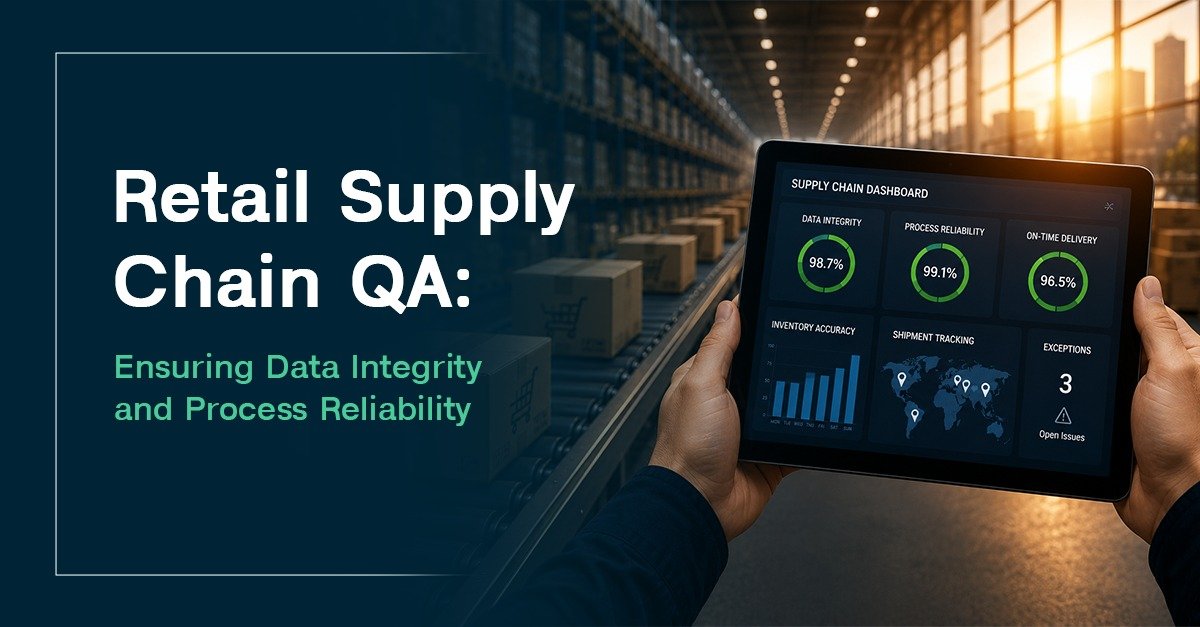
Retail supply chain QA exists to close this gap—not as a periodic validation exercise performed before major releases, but as a continuous, embedded quality discipline that safeguards the data accuracy, process integrity, and operational reliability on which retail businesses depend every day.
Its purpose is to ensure that systems perform consistently at every transaction volume, across every integration, and throughout every touchpoint in the supply chain ecosystem.
Why Retail Supply Chain QA Has Become a Business-Critical Discipline
A modern retailer operates across thousands of SKUs, multiple sales channels, warehouses, and geographic regions—all synchronized in near real time through API integrations, EDI connections, and cloud-based platforms that continuously exchange data with minimal or no human intervention.
In this environment, a single failed data synchronization between a warehouse management system and an e-commerce platform does not result in a minor reporting discrepancy. It can trigger stockouts of bestselling products, overselling during peak demand or flash sales, shipping delays that erode customer trust at scale, and inventory discrepancies that finance, operations, and commercial teams are unable to reconcile.
What begins as a data quality issue quickly escalates into an operational, financial, and customer experience problem that affects the entire retail ecosystem.
The systems involved—ERP platforms, warehouse management systems, order management systems, point-of-sale platforms, and the integrations that connect them—are individually sophisticated but collectively vulnerable at the points where they exchange data. It is at these handoffs that retail supply chain failures most consistently originate, and it is precisely this area that traditional software testing approaches are least equipped to address.
Retail supply chain QA is the discipline of testing and validating the systems, integrations, and data flows that keep retail operations functioning—from procurement and inventory management to order fulfillment and last-mile delivery. Its purpose is to identify and prevent failures before customers experience them and before they create measurable financial impact.
How Data Integrity Testing Prevents Inventory and Order Management Failures
Data integrity testing is the operational backbone of a reliable retail supply chain. It ensures that data moving between systems remains accurate, consistent, and complete at every handoff, because in a retail environment, data that is accurate within an individual system but becomes corrupted during transmission is effectively no different from data that was never accurate in the first place.
Referential integrity validation confirms that every order is linked to a valid customer, every SKU to a valid supplier, and every shipment to a valid order. Without this validation, retail systems accumulate orphaned records orders with no customer, inventory with no source, shipments with no destination that create operational failures nobody anticipated and nobody can easily trace.
Null and missing value detection catches the small gaps that produce large downstream consequences. A missing warehouse code or an empty SKU field may appear inconsequential in isolation. Within a fulfillment workflow, it breaks the process entirely at the point furthest from where the gap was introduced and closest to where the customer is waiting.
Data synchronization testing ensures that inventory counts, pricing, and order status remain consistent across POS, OMS, WMS, and e-commerce platforms in real time not eventually, not approximately, but with the precision and currency that retail operations require to prevent the phantom inventory, overselling, and order status discrepancies that erode customer trust and operational efficiency simultaneously.
Duplicate and reconciliation testing ensures that the same order, customer, or SKU is not represented differently across systems one of the most common causes of inventory mismatches and reporting errors in large retail environments, and one of the most difficult to diagnose without a testing framework specifically designed to surface it.
When these checks are absent or inadequate, supply chain leaders manage a consistent and familiar problem: numbers that do not reconcile, explanations that satisfy nobody, and a growing organizational skepticism toward the data the business runs on.
Why Retail Supply Chains Fail Even When Every System Appears Integrated
This is one of the most common questions retail technology leaders bring to quality engineering discussions, and the answer often comes as a surprise.
Most retail supply chain failures do not originate within individual systems. They occur at the handoffs between them—where data, processes, and transactions move across multiple platforms, integrations, and operational boundaries.
Each system within a retail supply chain may pass its individual tests in isolation. The procurement platform functions correctly. The inventory management system functions correctly. The warehouse management system functions correctly. The e-commerce platform functions correctly.
Yet the supply chain still fails—not because the individual systems are defective, but because the data exchanges between those systems were never validated under real-world operating conditions, realistic data volumes, and actual timing constraints.
In complex retail environments, the greatest risks do not reside within the systems themselves; they emerge at the intersections where those systems interact.
Several recurring patterns consistently drive supply chain failures across retail environments.
Integration testing gaps leave the critical boundaries between systems unvalidated—the very points where data corruption, synchronization failures, and schema mismatches are most likely to occur. Testing individual systems in isolation does not reveal these issues. Only integration testing specifically designed to validate cross-system data exchange can uncover them.
Version and update risks introduce failures through routine platform changes that unintentionally alter data exchange rules with connected systems. A seemingly minor update—such as a change to an API response format, field name, or data type—can silently disrupt every downstream system that depends on the previous structure, often remaining undetected until a production incident occurs.
Manual workaround drift creates inconsistencies through quick fixes implemented under operational pressure. While each workaround may be justified at the time, their cumulative effect introduces variations in data handling that gradually evolve into reporting discrepancies and operational anomalies that are difficult to trace back to a single root cause.
Peak-load failures expose supply chain systems that perform reliably under normal conditions but break down under the concurrent demand generated by flash sales, seasonal peaks, and promotional events. These failures often occur during periods of highest revenue opportunity—precisely because those moments create transaction volumes that conventional testing never replicated.

What Process Reliability Testing Requires in a Retail Supply Chain
Process reliability testing validates whether retail supply chain processes can withstand real operating conditions—not idealized scenarios or simplified test environments, but the actual transaction volumes, data variability, and failure conditions encountered in production.
End-to-end order lifecycle testing follows every order from placement through final delivery, validating each system involved along the journey—including payment processing, inventory allocation, warehouse pick-and-pack operations, carrier integrations, and delivery confirmation.
This approach uncovers the failures that individual system testing often misses—issues that only become visible when the entire transaction flow is executed across the complete system landscape under realistic operating conditions.
Performance and load testing simulate high-demand events—such as Black Friday, festive season surges, and flash promotions—before they occur in production. These tests help retailers understand how their systems behave under the transaction volumes and concurrent user loads that peak business periods generate.
Retail organizations that discover their system limitations during live trading events pay the highest possible price for that discovery through lost revenue, operational disruption, and diminished customer trust. Those that uncover these limitations during performance testing can address them proactively, before customers are impacted and commercial performance is affected.
Failover and resilience testing validates how the supply chain behaves when one of its critical systems becomes unavailable. It determines whether the remaining systems continue operating with graceful degradation or whether the disruption cascades into a broader operational failure.
Most retail organizations cannot answer this question with confidence—not because they lack robust systems, but because they have never systematically tested these scenarios under controlled conditions. Resilience is not proven by assuming systems will recover; it is proven by validating how they respond when failures inevitably occur.
Compliance and audit-readiness testing ensures that retail systems operating across multiple regions adhere to the tax, labeling, and data privacy regulations applicable to each jurisdiction. It validates not only that systems generate the required outputs, but also that those outputs meet the specific regulatory and compliance standards expected in every market in which the organization operates.
Building a QA Strategy That Scales With the Supply Chain
A retail supply chain QA strategy that remains effective at scale requires a fundamental shift in how organizations approach testing—from periodic validation performed at release gates to continuous, embedded quality engineering that is integrated into the day-to-day operation of the supply chain.
Begin with a data integrity audit. Before introducing new testing processes, map how data flows across the supply chain—between which systems, through which integrations, and under what timing constraints—and identify the highest-risk handoff points. This audit helps reveal the gap between where testing is currently focused and where the supply chain is actually most vulnerable.
Automate regression and integration testing. Manual testing cannot keep pace with the speed of change in a modern retail technology ecosystem. Automated test suites that run with every system update and integration change can identify issues before they reach production, providing a level of continuous coverage that manual testing cannot sustain at the frequency today’s retail operations demand.
Test under real-world conditions — not ideal ones. Simulate actual peak traffic volumes, realistic data loads, and genuine failure scenarios. A testing environment that does not accurately reflect how the supply chain behaves under stress will not uncover the failures that emerge when that stress occurs in production.
Build continuous monitoring into the QA process. Data integrity is not a condition that can be established and sustained through a one-time test. It requires continuous monitoring to detect the small inconsistencies that emerge over time before they accumulate into reporting discrepancies and operational failures that periodic testing alone could never anticipate. .
Engage domain-specific QA expertise. Testing a retail supply chain requires a deep understanding of retail-specific workflows, integration patterns, and compliance requirements—areas that generic software testing approaches often fail to address adequately. The gap between generic QA coverage and domain-specific QA coverage is where many of the most significant retail supply chain failures originate.
How Quality Matrix Helps Retailers Ensure Data Integrity and Process Reliability
Quality Matrix partners with retail and e-commerce organizations to build supply chain QA strategies that safeguard both data accuracy and operational reliability across the full complexity of modern retail technology ecosystems.
End-to-end supply chain testing validates the entire retail technology ecosystem—including all interconnected systems and their integrations—ensuring that test coverage reflects how the supply chain actually operates in practice, rather than how individual systems are documented to function in isolation.
Data integrity and reconciliation testing validate referential integrity, identify synchronization gaps, and establish reconciliation frameworks that keep inventory, order, and customer data consistent across every system in the supply chain—detecting data quality issues that individual system testing would otherwise fail to uncover.
Automated regression and integration testing establish automation frameworks integrated with CI/CD pipelines, enabling continuous validation of every system update and new integration rather than periodic testing cycles. This approach delivers the speed, consistency, and coverage that modern retail technology environments require.
Peak load and performance testing simulate high-demand events—such as flash sales, festive season traffic, and promotional surges—before they occur in production, enabling retail organizations to validate system resilience and address potential bottlenecks before customers experience any disruption.
Continuous quality monitoring enables retail organizations to move beyond one-time testing and adopt ongoing data quality governance—detecting data drift and inconsistencies before they escalate into larger operational failures that periodic testing alone could not predict.
As a trusted software testing partner for enterprise organizations across retail, manufacturing, banking, and healthcare, Quality Matrix combines deep technical expertise with industry-specific knowledge to support the complex demands of modern retail supply chains—at any scale and during any season.
Conclusion
Retail supply chains run on data, and that data creates business value only when it can be trusted—by operations teams managing inventory, commercial teams planning demand, finance teams reconciling transactions, and customers expecting their orders to arrive exactly as promised.
When inventory counts are inaccurate, order statuses fall out of sync, or warehouse systems silently drift out of alignment with e-commerce platforms, these are not isolated technical issues confined to a single system. They are direct threats to customer trust, operational efficiency, and revenue—threats that compound with every transaction cycle that passes without detection.
Retail supply chain QA exists to prevent that compounding effect. It is not a one-time initiative with a defined end date, but an ongoing quality engineering capability that evolves alongside the business, its integrations, and the peak-demand periods that define retail’s most critical moments.
Retailers that invest in this capability do more than avoid costly disruptions. They build resilient supply chains that customers, partners, and internal teams can depend on—consistently, at scale, and under any market condition.
If your organization is looking for a quality engineering partner that understands both the technical complexity and the operational realities of modern retail supply chains, Quality Matrix is ready to help.
Connect with our QA experts to build a resilient, scalable, and reliable supply chain quality strategy that protects data integrity, operational performance, and customer trust—across every system, integration, and transaction that drives your business.
FAQs
Yes. We design QA strategies for omnichannel retail environments to ensure that inventory, pricing, and order data remain accurate, consistent, and synchronized across all sales channels.
We simulate peak traffic conditions and evaluate inventory, checkout, and warehouse systems under high load to identify and resolve issues before critical sales periods.
Automated tests often validate individual systems but miss integration gaps. We focus on identifying and testing these critical handoffs to uncover issues at their root cause.
It applies to retailers of all sizes. Implementing strong QA practices early helps prevent costly errors and scalability challenges as operations expand.
If you’re facing inventory mismatches, integration issues, or challenges driven by rapid growth, we can assess your systems and identify quality risks before they impact operations.