 Quality Matrix
Quality engineering is undergoing its most significant transformation since the introduction of test automation.
For years, enterprises invested heavily in automation to solve the scalability challenge — and automation delivered measurable value. It reduced manual effort, accelerated regression cycles, and introduced a level of consistency in software validation that manual testing alone could never achieve.
But automation, as many enterprise QA leaders now recognise, has its limits.
Scripts break. Maintenance overhead continues to grow. Coverage decisions remain static while applications evolve dynamically. And the core operating model — write a test, execute a test, repair a broken test — still depends heavily on continuous human intervention to keep pace with modern software delivery.
That model is no longer sufficient for today’s complexity, release velocity, and business expectations.
The next evolution in quality engineering is designed to solve exactly this problem.
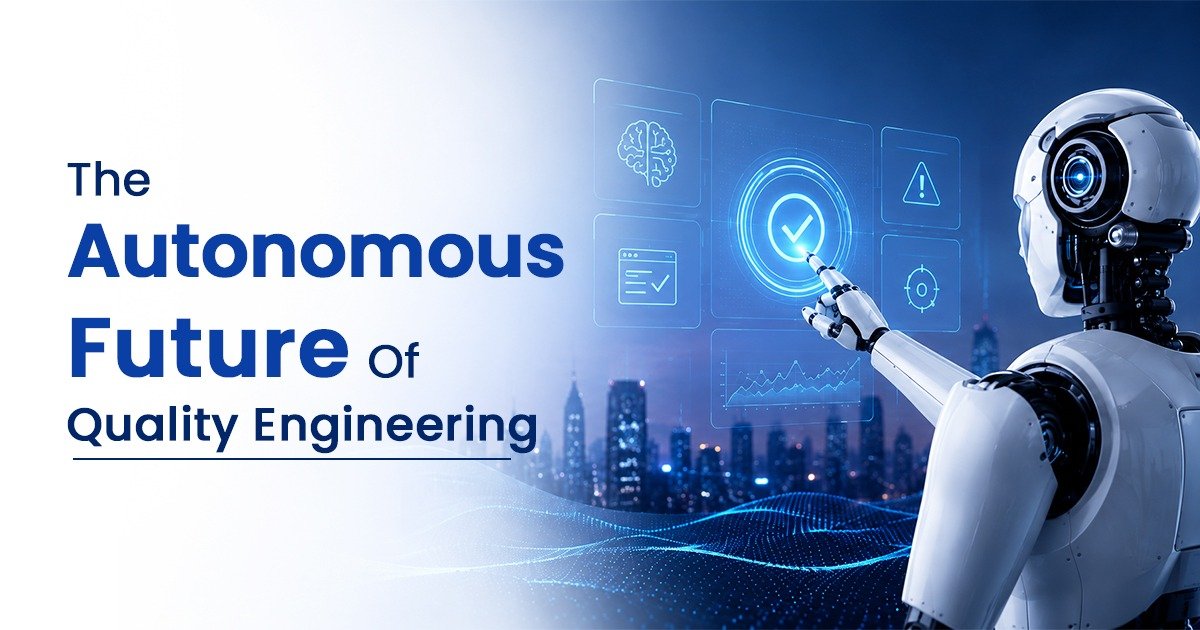
Autonomous quality engineering does not simply automate testing. It creates intelligent testing ecosystems that learn from every execution, adapt to application changes in real time, predict where failures are most likely to occur, and continuously improve without proportional increases in manual effort.
For enterprise organisations operating at scale, this is no longer an experimental idea. It is the direction the industry’s most mature quality engineering functions are already moving toward.
And the difference between organisations that have embraced this shift and those still dependent on traditional automation models is becoming increasingly measurable — in release frequency, defect escape rates, operational efficiency, and engineering capacity recovered.
Strip away the buzzwords, and autonomous quality engineering comes down to one core idea: testing systems that become smarter over time without requiring constant human intervention to make them so.
Traditional automation is inherently static. It performs exactly as programmed — no more, no less. When applications change, scripts break. When new risk areas emerge, coverage gaps appear. When false positives flood the pipeline, engineers must manually separate real defects from noise.
Autonomous QA systems operate differently.
They learn from every execution. They adapt dynamically as applications evolve. They identify where failures are most likely to occur and prioritise testing accordingly. They self-heal when scripts break. And they continuously refine detection accuracy using real production behaviour — not just assumptions made when the tests were originally written.
The result is a quality engineering function that becomes more effective with every release cycle, rather than one that requires ever-increasing manual effort simply to keep pace with change.
The Four Capabilities That Make It Real
1. Intelligent Test Automation That Thinks, Not Just Executes
Traditional automation executes. Autonomous automation decides.
AI-powered testing systems analyse application behaviour, historical failure patterns, and the impact of code changes to determine what should be tested, in what sequence, and at what depth — dynamically, with every build.
Coverage decisions are no longer driven by static test plans created months earlier. They are guided by live data, evolving risk patterns, and real business impact.
The outcome is faster delivery pipelines, smarter test coverage, and quality engineering effort focused precisely where it delivers the greatest protection to the business.
2. Self-Healing Frameworks That Never Go Stale
Ask almost any QA team what consumes the most automation maintenance time, and the answer is usually the same: broken locators, failed scripts, and the endless cycle of updating automation every time the UI changes.
Self-healing automation is designed to eliminate that cycle.
When an interface element changes, the system automatically detects the discrepancy, identifies the updated element, repairs the script, and continues execution — without requiring engineer intervention.
Automation stays current dynamically. Maintenance overhead drops significantly. And the engineering effort once spent repairing scripts can instead be redirected toward expanding coverage, improving quality strategy, and building more intelligent testing ecosystems.
3. Predictive Defect Analysis That Finds Problems Before They Form
By continuously analysing historical defect data, code change patterns, release behaviour, and production incident history, AI-driven systems can identify the areas of an application most likely to fail before testing even begins.
High-risk modules are surfaced early. Critical workflows receive deeper validation. And QA teams enter each release cycle with far greater clarity on where testing effort will deliver the greatest impact.
The shift from reactive defect detection to predictive defect prevention is one of the most significant competitive advantages autonomous quality engineering provides.
Organisations that reach this stage no longer spend their time simply managing quality failures.
They start preventing them.
4. Continuous Learning That Compounds Over Time
Every test execution generates data. Every production incident reveals insights about system behaviour. Every release cycle uncovers patterns that were previously invisible.
Autonomous QA systems capture all of this information and use it to improve continuously over time.
Detection accuracy increases. False positive rates decline. Coverage decisions become more precise. And the quality system operating six months into autonomous QA is measurably more intelligent than the one that began — because it has been learning continuously from every release, every defect, and every production outcome.
This compounding improvement is what transforms autonomous quality engineering from a short-term efficiency initiative into a long-term strategic advantage.

What This Delivers for the Business
The business case for autonomous quality engineering is not theoretical. It appears in the metrics enterprise leadership cares about most.
Release cycles accelerate because intelligent test prioritisation removes the bottlenecks that slow traditional delivery pipelines. Production defect rates decline because predictive analysis identifies risks before they reach end users. Testing costs decrease because self-healing automation reduces maintenance overhead while AI-driven prioritisation eliminates redundant effort.
Engineering capacity is recovered because teams spend less time maintaining automation and more time building meaningful coverage and improving quality strategy.
And perhaps most importantly, release confidence increases.
When quality systems are continuously learning, adapting, and improving, organisations no longer have to choose between speed and quality.
They achieve both.
Where Most Enterprises Are Right Now
Most enterprise QA functions today sit somewhere between traditional automation and the early stages of intelligent testing.
They have automation frameworks. They have some AI-enabled tooling. But in many cases, these capabilities still operate in isolation rather than as part of a cohesive autonomous quality ecosystem.
Meanwhile, the gap between organisations that are experimenting with intelligent testing and those that have operationalised autonomous quality engineering at scale is becoming increasingly visible.
The good news is that this transition does not require rebuilding everything from scratch.
It requires a clear strategy, the right implementation approach, and a deliberate effort to embed intelligence into the quality infrastructure that already exists.
How Quality Matrix Builds Autonomous QA for Enterprises
At Quality Matrix, autonomous quality engineering is not just a concept we discuss. It is a capability we design and implement — tailored to the complexity, scale, and risk profile of each enterprise we support.
Through our TGen AI platform and intelligent QA frameworks, we enable self-healing automation, predictive defect analysis, AI-driven test prioritisation, and continuous learning systems that integrate seamlessly into existing development and delivery pipelines.
The result is a quality engineering function that becomes smarter with every release — protecting the business today while building the foundation for scalable, reliable software delivery in the future.
We do not just automate testing.
We engineer intelligent quality systems built for the future of software innovation.
Ready to move your organisation toward autonomous quality engineering?
 info@quality-matrix.com
  quality-matrix.com
FAQs
- Autonomous testing does not replace QA professionals. It enhances their effectiveness.
AI-driven testing systems can automate repetitive execution, improve defect detection, prioritise risk, and reduce maintenance overhead. But strategic validation, exploratory testing, business-context understanding, and user experience evaluation still require human expertise.
The future of quality engineering is not human versus AI. It is intelligent collaboration between human insight and autonomous systems.
At Quality Matrix, we help enterprises build intelligent QA ecosystems through AI-driven automation, predictive testing strategies, scalable frameworks, and modern quality engineering practices aligned with long-term business growth.
Yes. Modern autonomous QA solutions are built to integrate seamlessly with existing testing tools, CI/CD pipelines, DevOps environments, and enterprise applications — without requiring organisations to completely rebuild their existing QA ecosystem.
- If your teams are struggling with rising test maintenance effort, slower release cycles, repetitive manual validation, or unstable automation frameworks, it may be the right time to adopt autonomous QA practices.
These challenges are often signs that traditional automation models are reaching their scalability limits — and that quality engineering needs to become more intelligent, adaptive, and predictive to keep pace with modern software delivery.
.Yes. AI-driven QA systems use intelligent pattern recognition, contextual validation, and adaptive learning to reduce inaccurate alerts — enabling teams to focus on genuine defects and business-critical failures instead of spending time investigating false positives