 Quality Matrix
Many enterprises still view software testing as a necessary cost of software delivery. Budgets are allocated to quality assurance, teams are staffed, and tools are implemented primarily to prevent defects and minimize production failures.
However, the most successful organizations have fundamentally changed the way they approach quality.
Today, an AI-Driven Testing Center of Excellence (TCoE) is no longer just a testing function—it has evolved into a strategic business enabler that drives innovation, accelerates digital transformation, enhances customer experiences, and reduces operational risk.
As software ecosystems grow more complex and release cycles continue to accelerate, traditional testing approaches are no longer sufficient. Organizations need a modern TCoE that goes beyond defect detection and delivers measurable business value.
The conversation is no longer centered on, “How much does testing cost?” Instead, it has shifted to a far more strategic question: “How much value does quality create?”
What Is a Test Center of Excellence (TCoE)?
A Testing Center of Excellence (TCoE) is a centralized Quality Engineering framework that establishes standardized testing processes, governance models, automation strategies, tools, metrics, and best practices across an organization.
Traditionally, TCoEs have focused on:
- Reducing testing costs
- Standardizing Quality Assurance processes
- Optimizing resource utilization
- Improving testing efficiency
- Managing enterprise-wide testing activities
While these objectives remain important, modern organizations are expanding the role of TCoEs to support broader business priorities.
Today’s AI-Driven Testing Centers of Excellence combine Quality Engineering, intelligent automation, predictive analytics, and continuous testing to deliver not only higher software quality but also measurable business outcomes. They enable organizations to accelerate digital transformation, improve release confidence, enhance customer experiences, and reduce operational risk.
As a result, the TCoE is evolving from an operational support function into a strategic capability that directly contributes to business performance and long-term organizational success.
Why Traditional TCoEs Were Viewed as Cost Centers
Historically, testing was treated as a distinct phase at the end of the software development lifecycle.
Success was measured using operational metrics such as:
- Number of test cases executed
- Defects identified
- Test execution effort
- Resource utilization
- Cost savings
While these metrics provided visibility into testing activities, they offered limited insight into how quality influenced overall business performance.
As a result, many organizations viewed testing as an operational overhead rather than a strategic investment.
This perception created several challenges, including:
- Limited innovation within testing teams
- Delayed involvement of quality throughout the delivery lifecycle
- Reactive approaches to defect management
- Difficulty in justifying quality investments
- Reduced focus on customer experience
In today’s digital-first economy, this approach is no longer sustainable. Organizations can no longer afford to treat quality as a downstream activity. Instead, it must be embedded throughout the software delivery lifecycle and positioned as a strategic capability that directly contributes to business growth, customer satisfaction, and operational resilience.
The Shift Toward Value-Driven Quality Engineering
Organizations increasingly recognize that software quality has a direct impact on revenue, customer retention, brand reputation, and operational efficiency.
As a result, modern Quality Engineering has shifted its focus from defect detection to defect prevention.
Rather than measuring success solely through operational metrics such as defect counts, organizations are evaluating quality based on the business outcomes it delivers, including:
- Customer satisfaction
- Release velocity
- Production stability
- Business risk reduction
- Digital experience quality
- Return on quality investments
This evolution is transforming the role of the Testing Center of Excellence (TCoE) from an operational support function into a strategic, value-generating business capability that enables organizations to accelerate innovation, improve customer experiences, and deliver more reliable digital products and services.

How AI-Driven TCoEs Create Business Value
Accelerating Time-to-Market
Modern enterprises operate in highly competitive environments where speed, agility, and reliability are critical to business success.
An AI-Driven Testing Center of Excellence (TCoE) leverages intelligent automation, continuous testing, and predictive quality practices to streamline testing processes and accelerate software delivery.
By reducing testing cycle times and improving delivery efficiency, organizations can release software faster, respond more effectively to changing market demands, and realize business value sooner.
Enhancing Customer Experience
Software quality has become a critical competitive differentiator in today’s digital economy.
Customers expect seamless, reliable, and consistent digital experiences across applications, platforms, and devices. By validating critical customer journeys and identifying potential risks early in the delivery lifecycle, a modern Testing Center of Excellence (TCoE) enhances reliability, improves usability, and elevates overall customer satisfaction.
Reducing Business Risk
Production failures can lead to significant financial losses, regulatory non-compliance, and reputational damage.
AI-powered testing enables organizations to identify high-risk areas, anticipate potential failures, and address issues proactively before they impact end users. This predictive and preventive approach strengthens software reliability and significantly reduces overall business risk.
Supporting Digital Transformation
Organizations undergoing digital transformation often encounter challenges related to cloud migration, API integrations, AI-enabled systems, and increasingly complex enterprise applications.
A mature Quality Engineering Services framework ensures that quality is embedded throughout these transformation initiatives, enabling organizations to manage complexity, reduce risk, and deliver reliable digital solutions at scale.
Enabling Data-Driven Decision Making
Modern Testing Centers of Excellence (TCoEs) leverage analytics, AI, and real-time quality insights to enable more informed and strategic decision-making.
Leadership teams gain enterprise-wide visibility into key indicators such as:
- Release readiness
- Risk exposure
- Testing effectiveness
- Automation performance
- Emerging quality trends
These insights empower organizations to make faster, data-driven decisions, improve delivery confidence, and proactively manage risks across the software lifecycle.
The Role of AI-Powered Testing in Modern TCoEs
Artificial Intelligence is transforming the way organizations approach software quality.
AI-powered testing capabilities now include:
- Intelligent test case generation
- Self-healing test automation
- Predictive defect analytics
- Synthetic test data generation
- Risk-based testing recommendations
- Autonomous testing workflows
These capabilities enable Quality Engineering teams to increase efficiency, expand test coverage, and significantly reduce manual effort.
As AI technologies continue to mature, organizations are moving toward autonomous Quality Engineering models that continuously optimize testing processes, improve decision-making, and proactively enhance software quality across the entire delivery lifecycle.
Key Components of a Modern AI-Driven TCoE
Organizations seeking to modernize their Enterprise Testing Strategy should focus on the following key areas:
Governance and Standardization
Establish consistent testing frameworks, governance models, metrics, and best practices to drive quality, consistency, and accountability across teams.
Intelligent Automation
Implement scalable automation capabilities that support continuous testing, improve efficiency, and accelerate software delivery.
Quality Engineering Culture
Embed quality throughout the software development lifecycle, making it a shared responsibility rather than a final validation checkpoint.
AI and Analytics
Leverage AI-driven insights, predictive analytics, and data intelligence to improve quality outcomes and optimize testing investments.
Talent Transformation
Develop workforce capabilities in AI-powered testing, automation, cloud technologies, and modern engineering practices to build future-ready Quality Engineering teams.
Measuring the Business Impact of a TCoE
A modern Testing Center of Excellence (TCoE) should be measured using business-focused outcomes rather than purely operational metrics.
Key performance indicators should include:
- Reduction in production defects
- Faster release cycles
- Improved automation effectiveness
- Higher customer satisfaction
- Reduced business risk
- Increased application reliability
- Stronger compliance outcomes
These metrics provide a clear view of how quality initiatives contribute to business growth, operational resilience, and overall organizational performance.
The Future of AI-Powered Quality Engineering
The future of software testing lies in intelligent, autonomous, and business-driven Quality Engineering.
Leading enterprises are investing in capabilities such as:
- AI-Driven Testing Centers of Excellence (TCoEs)
- Autonomous Testing
- Predictive Quality Analytics
- Continuous Quality Engineering
- Intelligent Test Automation
- Synthetic Test Data Management
Organizations that adopt these capabilities will be better positioned to accelerate innovation, improve operational efficiency, and deliver high-quality software at speed and scale. In doing so, they will gain a sustainable competitive advantage in an increasingly digital and customer-centric marketplace.
Conclusion
The evolution of the Testing Center of Excellence (TCoE) reflects a broader transformation taking place across the software industry.
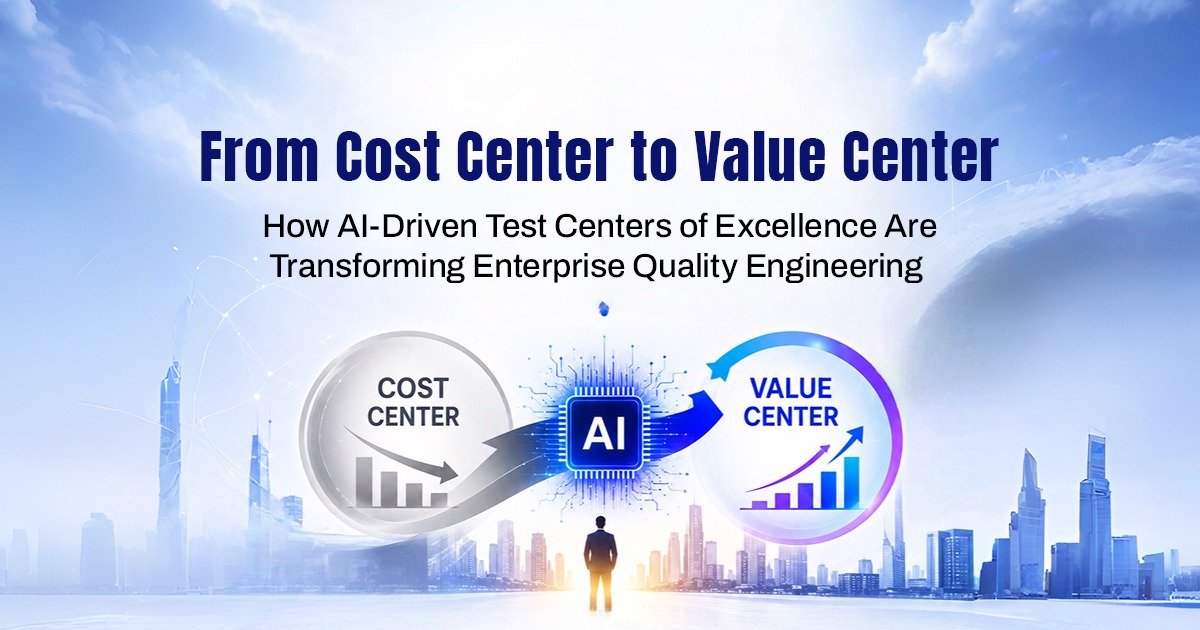
What was once viewed as an operational cost center has evolved into a strategic value driver that accelerates innovation, enables digital transformation, reduces business risk, and enhances customer experiences.
An AI-Driven Testing Center of Excellence empowers organizations to move beyond traditional testing approaches and embrace a future powered by intelligent automation, predictive analytics, and continuous Quality Engineering.
Quality is no longer solely about preventing defects—it is about creating measurable business value and establishing a sustainable foundation for long-term business success.
FAQs
An AI-Driven Test Center of Excellence (TCoE) is a centralized quality engineering framework that combines artificial intelligence, automation, governance, and analytics to improve software quality, accelerate delivery, and support business objectives.
A Test Center of Excellence improves software quality by standardizing testing processes, implementing test automation, enabling continuous testing, reducing defect leakage, and improving test coverage across the software development lifecycle.
Enterprises invest in AI-Driven TCoEs to accelerate digital transformation, improve customer experience, reduce software delivery risks, optimize testing costs, and increase release velocity.
The benefits include faster releases, improved software quality, reduced production defects, enhanced automation efficiency, better compliance, lower operational costs, and improved business outcomes.
AI transforms software testing through intelligent test generation, predictive defect analysis, self-healing automation, synthetic test data creation, risk-based testing, and autonomous testing capabilities.