 Quality Matrix
According to the 2025 EY-Parthenon Generative AI in Banking survey, 47% of banks now have live AI applications in production.
What began as cautious experimentation is rapidly becoming part of core banking operations from fraud detection and loan processing to customer communication and compliance workflows.
But AI in banking introduces a category of risk that conventional software never did.
A wrong AI output is not just a technical defect. In banking, it can become a compliance violation, a customer trust crisis, or a financial risk event within a single transaction cycle. As banks accelerate AI adoption, quality engineering is becoming the critical discipline that determines whether these systems remain accurate, reliable, compliant, and safe at enterprise scale.
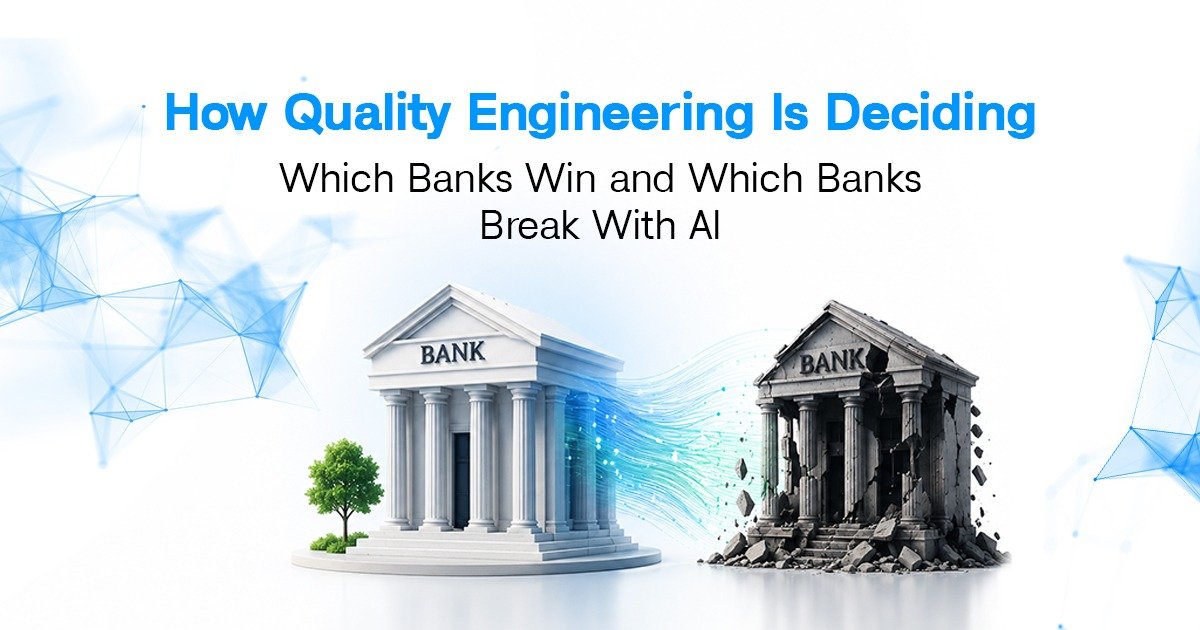
The leading banks will not simply be the ones adopting AI fastest.
They will be the ones building the strongest quality engineering frameworks around it.
Why AI in Banking Is a Fundamentally Different Quality Problem
Precision matters here. AI systems are not simply more complex versions of conventional banking software. They represent a categorically different quality challenge.
Conventional banking applications are deterministic. A specific input always produces a predictable output. A loan calculation follows the same formula every time. A payment routing system follows predefined logic. A fraud rule either triggers or it does not. QA built around this predictability works well because the expected output is always known in advance.
AI systems operate differently.
The same prompt can generate different responses across different sessions. Models may behave differently as data changes over time. AI-generated content can appear contextually correct while being factually inaccurate, misleading, or non-compliant with no error signal to indicate the problem.
This is not a theoretical concern. Regulators are already responding to it directly.
FINRA’s 2026 Regulatory Oversight Report makes the stakes explicit. AI-powered banking operations must meet the same compliance functions as any other banking system and banks must build governance structures ensuring that AI deployment aligns with established supervisory, communications, and recordkeeping obligations without exception.
The report flags accuracy and hallucinations as perhaps the most immediate concern in this environment. AI models produce plausible-sounding but factually incorrect information with striking confidence. When such outputs appear in investor communications, marketing materials, or compliance recommendations, the potential for customer harm, unsuitable product recommendations, or misinterpretation of regulatory requirements is substantial.
Quality engineering is the discipline that manages the gap between what AI can do and what it can do safely, reliably, and compliantly at enterprise scale.
The Five Quality Engineering Imperatives for AI in Banking
1. Hallucination Detection and Output Accuracy Validation
An inaccurate AI-generated response in banking is never just a software issue. Depending on where it surfaces in a lending decision, a compliance recommendation, or a customer-facing communication it can become a regulatory exposure, a financial liability, or a reputational incident.
Quality engineering must validate AI outputs against trusted financial and regulatory data while testing how models behave under edge cases and adversarial prompts. This requires continuous evaluation frameworks that measure output accuracy, reliability, and risk thresholds calibrated differently depending on the business use case and its regulatory sensitivity.
A hallucination in a low-stakes customer FAQ carries different consequences than a hallucination in a credit assessment output. Quality engineering must treat them accordingly.
2. Bias and Fairness Testing in High-Stakes Financial Decisions
As AI becomes embedded in lending, insurance, and risk assessment workflows, regulatory scrutiny around fairness and discriminatory outcomes is intensifying significantly.
A model may appear accurate in aggregate while still producing systematically biased outcomes for specific demographic groups outcomes that violate fair lending obligations, trigger regulatory action, and cause genuine harm to the customers affected.
Quality engineering addresses this through fairness testing, protected-group analysis, and continuous bias monitoring ensuring AI-driven financial decisions remain compliant, defensible, and equitable across the full customer population the model serves.
3. Regulatory Compliance and Explainability Validation
Financial regulators now expect AI-powered banking systems to meet the same governance, monitoring, and compliance standards as every other system operating within the institution.
This includes validating not only AI outputs but also the ability to explain how those outputs were generated in terms that satisfy both internal audit requirements and external regulatory examination.
Quality engineering ensures AI-driven decisions remain transparent, traceable, and auditable through explainability validation, monitoring frameworks, and human-in-the-loop quality controls that produce the documented evidence regulators increasingly require.
4. Synthetic Data Testing and Data Privacy Validation
Banking AI systems require large volumes of realistic testing data. Using real customer information to generate that coverage introduces significant privacy and compliance risks under GDPR, CCPA, and sector-specific financial regulations.
Synthetic data allows organizations to test AI systems at the depth and scale required without exposing sensitive financial data to test environments where it carries regulatory risk.
Quality engineering validates both the statistical reliability of synthetic data generation and the application’s ability to protect confidential customer information from unintended exposure across every integration point the system touches.
5. Continuous Monitoring and Model Drift Detection in Production
AI systems do not remain static after deployment. As transaction patterns, customer behavior, and market conditions evolve, model accuracy and reliability can degrade over time — gradually, invisibly, and without triggering any conventional monitoring alert.
Quality engineering provides continuous monitoring, drift detection, and revalidation mechanisms that identify performance degradation before it becomes visible in customer-facing outcomes or regulatory findings.
In banking, this is not an optional enhancement to an AI deployment programme. It is what regulators expect. And it is what separates responsible AI deployment from reckless AI deployment.

What Banking Leaders Need to Understand About the Regulatory Environment
The regulatory environment surrounding AI in banking in 2026 is not speculative. It is documented, increasingly specific, and actively enforced.
FINRA’s 2026 Regulatory Oversight Report has identified AI as a key compliance challenge area with specific guidance covering governance and risk management, supervision of AI outputs, testing and monitoring requirements, and the unique risks introduced by agentic AI systems operating with greater autonomy than previous generations of banking software. The report’s position is unequivocal: existing regulatory obligations apply to AI systems without exception.
The EU AI Act’s phased implementation classifies AI systems used in credit scoring, employment screening, and certain insurance applications as high-risk requiring mandatory risk assessments, bias audits, explainability documentation, and ongoing monitoring both before and after deployment.
Across jurisdictions, regulators are examining how banks govern their AI deployments with a level of scrutiny that is increasing, not stabilizing.
The banks with quality engineering infrastructure capable of meeting these requirements have deployment confidence and operational freedom. The banks without it face slow, expensive remediation or regulatory enforcement actions that are considerably more expensive still.
The Cost of Getting This Wrong
In banking, an AI failure is not a software defect with a contained technical resolution.
Incorrect AI-generated outputs in financial advice, lending decisions, fraud classification, or regulatory reporting can produce compliance violations, customer harm, and reputational damage that compounds long after the underlying model behavior is corrected.
The direct costs are quantifiable regulatory penalties, remediation programmes, operational disruption. The indirect costs are not customer attrition that accelerates quietly, reputational weight that makes the next product launch harder, regulatory relationships that take years to rebuild.
The cost of preventing these failures through strong quality engineering is significantly and consistently lower than the cost of managing them after they have occurred in production.
How Quality Matrix Helps Banks Deploy AI With Confidence
At Quality Matrix, we help banks build secure, compliant, and reliable AI systems through intelligent quality engineering, advanced automation, and regulatory-focused testing frameworks.
With deep experience in banking and financial services QA, we combine domain expertise with modern AI validation capabilities to support enterprise-scale AI adoption ensuring the systems banks deploy perform as intended not just at launch, but continuously throughout their production lifecycle.
Our capabilities for banking AI quality engineering include:
AI Application Quality Assessment — Evaluating AI systems for compliance risks, validation gaps, operational reliability, and deployment readiness before and after production entry.
Hallucination and Output Accuracy Testing — Building evaluation frameworks for factual accuracy, adversarial prompt testing, and output reliability across regulated banking use cases.
Bias, Fairness, and Explainability Validation — Testing AI models for fairness, transparency, explainability, and regulatory compliance across lending, fraud, and customer-facing financial applications.
Regulatory Compliance Testing Integration — Embedding automated compliance checks and governance controls directly into CI/CD and delivery pipelines so compliance validation is continuous rather than periodic.
Synthetic Test Data Engineering — Creating privacy-safe synthetic financial data that enables secure and scalable AI testing without exposing real customer information to test environments.
Production Monitoring and AI Governance — Implementing model monitoring, drift detection, revalidation workflows, and AI governance frameworks that maintain long-term reliability, compliance, and decision accuracy in production.
The Banks That Will Lead Are the Ones That Engineer Quality Into AI From the Start
AI adoption in banking is accelerating. The regulatory frameworks governing it are tightening. And the gap between banks with mature AI quality engineering capabilities and those without is widening with every quarter.
The institutions that will lead are not necessarily the ones that moved fastest on AI.
They are the ones that moved deliberately building the quality engineering infrastructure that allows AI systems to operate reliably, fairly, and compliantly at the scale and scrutiny that banking demands.
Quality engineering is not the final checkpoint before an AI system goes live.
It is the ongoing discipline that determines whether that system remains worthy of the trust banks, regulators, and customers place in it every day it operates in production.
Conclusion
There is a persistent misconception in banking technology discussions that quality engineering is a friction point in GenAI adoption, a cautious function that slows down the pace of innovation that the business is pushing for.
The reality is precisely the opposite.
In 2026, quality engineering is not the department that says no to AI. It is the function that makes AI in banking safe enough to say yes.
Frequently Asked Questions
Yes. Traditional QA validates predictable systems, while GenAI requires specialized testing for hallucinations, bias, explainability, and regulatory compliance. Most banks benefit from combining internal QA expertise with GenAI-focused quality engineering.
Banks use synthetic financial data that mirrors real-world patterns without containing actual customer information. Quality engineering ensures this data is privacy-safe, realistic, and suitable for high-risk AI testing.
GenAI systems require continuous monitoring for drift, accuracy decline, fairness issues, and changing data patterns. Ongoing quality engineering helps detect risks early before they impact customers or compliance.
Most banks can establish foundational GenAI quality frameworks within 8–12 weeks, while enterprise-scale AI quality governance and monitoring typically evolve over several months through phased implementation.
Strong GenAI quality engineering reduces compliance risk, prevents costly AI failures, and enables faster, safer AI adoption. In banking, the cost of prevention is significantly lower than the cost of regulatory or reputational damage.