 Quality Matrix
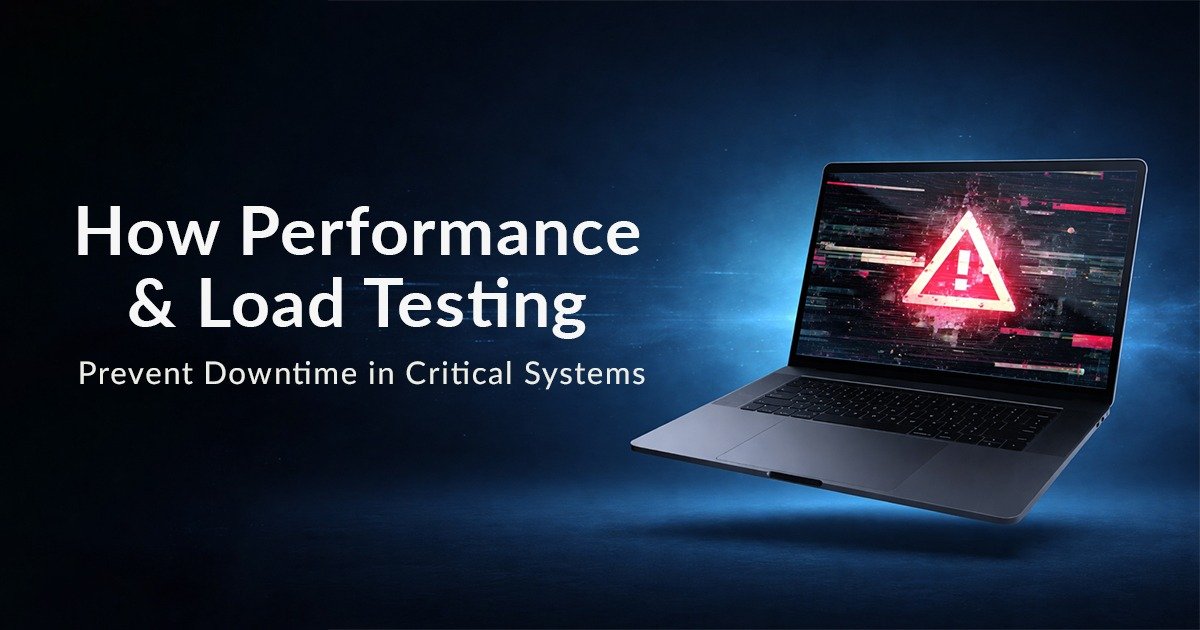
In today’s digital-first world, system downtime is no longer just a technical issue—it is a direct business risk. Even a few minutes of disruption can lead to significant consequences, from revenue loss to erosion of customer trust.
The impact is even more pronounced in critical systems such as banking platforms, healthcare applications, e-commerce ecosystems, and enterprise software, where performance and reliability are non-negotiable.
This is where performance and load testing move beyond being mere testing activities. They become a proactive strategy—one that ensures system resilience, safeguards user experience, and enables businesses to operate with confidence at scale.
Understanding Performance and Load Testing
Performance testing usually measures system speed, responsiveness, and stability.
And load testing is responsible for checking how the system performs under expected user traffic.
Together, they provide teams with critical insights into how applications perform in real-world conditions, allowing issues to be identified and addressed before they impact users.
Why Downtime Happens in Critical Systems
Downtime is rarely random—it is often the result of untested or underestimated system behavior under pressure. The following are some of the most common reasons why downtime occurs:
- Unexpected spikes in user traffic
- Poorly optimized database queries
- Inefficient APIs and service dependencies
- Infrastructure limitations
- Lack of scalability planning
In most cases, the root causes remain hidden until systems are subjected to realistic load and stress conditions, at which point they begin to impact the live environment.
How Performance Testing Prevents System Failures & Downtime
Performance testing helps identify system weaknesses early in the development lifecycle, enabling teams to:
- Detect bottlenecks in application performance
- Measure response times under varying conditions
- Ensure consistent system behavior across workloads
When these issues are uncovered early, organizations can address them proactively—preventing costly failures in production.

The Business Impact of Reliable Systems
Consistent performance and system stability translate directly into better user experiences, stronger customer trust, fewer operational disruptions, and enhanced business continuity.In high-stakes environments, reliability is no longer just a technical goal—it is a clear competitive advantage.
How Quality Matrix Enables High-Performance Systems
At Quality Matrix, performance and load testing extend beyond basic validation. They are built to reflect real-world system behavior and are closely aligned with business-critical outcomes.
By combining advanced testing strategies, real-world simulations, and scalable frameworks, we help enterprises:
- Identify performance risks early in the lifecycle
- Ensure system readiness under peak load and stress conditions
- Simulate real user scenarios across devices, networks, and environments
- Ensure stability across complex, distributed architectures
- Build resilient, high-performing applications that are consistently reliable across scale
Our approach ensures that performance is not treated as a final checkpoint, but as a continuous engineering priority embedded throughout the development lifecycle.
Conclusion
Downtime in critical systems is not just costly—it is preventable. With the right performance and load testing strategies, organizations gain the insights needed to build systems that perform reliably under real-world conditions.
Those that prioritize these practices are the ones that consistently deliver dependable digital experiences—regardless of scale.
FAQs
Performance and load testing ensure that systems can handle real-world demand without failures, helping to prevent downtime and performance issues.
Downtime is most commonly caused by traffic spikes, inefficient code, weak infrastructure, and a lack of scalability planning—issues that often remain unnoticed until systems are under pressure.
To be effective, performance testing should be conducted early and continuously throughout the development lifecycle, rather than being limited to pre-release stages. Continuous monitoring further helps in proactively identifying and preventing potential failures.
Importantly, performance testing is not limited to large-scale systems. Any application that handles user traffic can benefit from it to ensure reliability and scalability.
By enabling faster response times and smoother system behavior, performance testing directly contributes to a more reliable and seamless user experience.
Don’t let performance issues define your system reliability.
At Quality Matrix, we help enterprises stay ahead of downtime with performance and load testing strategies designed for real-world scale.